


Waste Tyre Scrap
Scrap Tyres Category
Product code- WT
Nylon Tyre Scrap
Product Code-WT001
The basic difference between a retreaded tire and a new one is that a retread has new tread rubber added to a previously used casing that has been designed for a multiple life. Retreads enable the bus operator to keep costs down, improve profit margins and increase the value received from tires.
The foundation of a successful retreading program starts with good tire casings. Structurally, new and retreaded tires are virtually the same. With proper care, commercial bus tires can be retreaded two or three times, providing hundreds of thousands of miles of additional tire life.
The tire casing will eventually wear beyond retreadability, but collecting that many miles takes a long time, and during this time, the tire being kept in use as a retread reduces the scrap tire problem and saves the bus fleet operator money.
Although tires are highly complex structures - among the most durable objects the rubber industry has ever created - bus operators are not overly fascinated by tire complexity. They simply demand that a tire support the bus and carry its "cargo” over the road surface with relative smoothness, and do those things for a long time with no trouble.
Redial Tyre Scrap
Product Code-WT002
Radial tires differ from traditional diagonal bias-ply tires in their construction, which minimizes tread wear and improves flexibility of the sidewall for better handling.
While tires may look simple they are actually made up of a series of layers of different materials. If we peeled back the tread in bias-ply tire one would see a nylon weave (these are the plies) beneath, running in a diagonal pattern meeting in the centerline of the face of the tire. The weave runs at an angle down the sidewalls to the bead — the part of the tire that fits on the wheel's rim. Nylon ply is stronger than polyester but compresses and sets when under load especially when left for periods of time, resulting in "flat areas" on the tire. Due to the direction the ply runs on these tires, the sidewalls don't bulge even if the tire is low. This design allows tread to wrap down over the sidewall because there is no transition point from the circumferential face to the
The average steel-belted radial gets about 100,000 miles (161,000 km) of wear, while the bias-ply tires are generally rated at about 30,000 miles (48,280 km).
Most of the tires on the road today are steel-belted radial tires.
Mixed Tyre Scrap
Product Code-WT003
Riding a bike is more eco-friendly than driving a car, but what do you do after those tires wear out, and you’re not able to patch them up? Many people and manufacturers realize the value of recycled rubber. Tires can be shredded and ground into various sizes of powders, crumbs and nuggets and made into new products.
Where To Take Old Tires and Tubes
While it’s possible for an auto place to accept and process bike tires and tubes (the rubber is the same either way), the charge for that service is greater than the costs of landfilling. The business model works for auto tire recycling because there are laws against putting auto tires in landfills in most U.S. states. This is not the case for bicycle tires. So if you are willing to pay a fee, then find an auto tire recycler and they should have no problems processing your bike tires and tubes. Some tire processors will take bike tires for free, some charge, and some don’t take them at all. The charge can be something nominal, like ten cents per tire, and sometimes processors will accept the tubing as well, as long as it’s off the rim. Check out our article on recycling car tires for tips on finding an auto tire recycler.
Price and Delivery time
| Waste Tyre Scrap | Minimum Order | Delivery Period | Price Per Ton |
|---|---|---|---|
| Nylon Tyres Scrap | 16 ton | 7-10 days | For pricing detall |
| Redial Tyres Scrap | 14 ton | 5-6 days | please, |
| Mixed Tyre Scrap | 16 ton | 4-5 days | contact us |
Tyres Scraps
Our 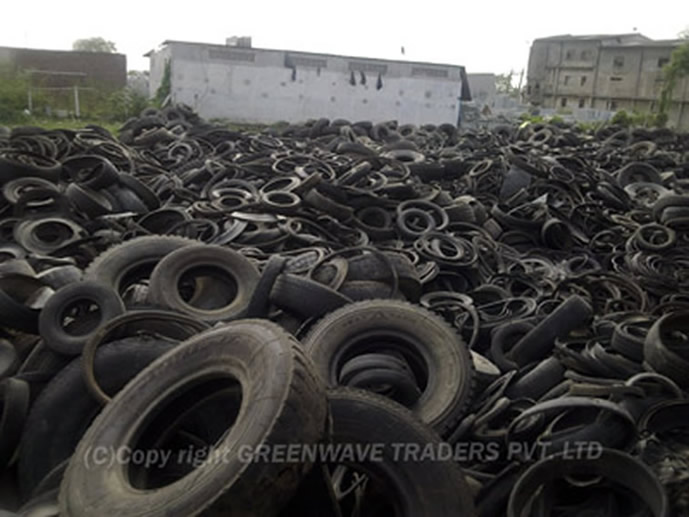 Waste Tyres Scrap at Pipodara, Surat,Gujarat.